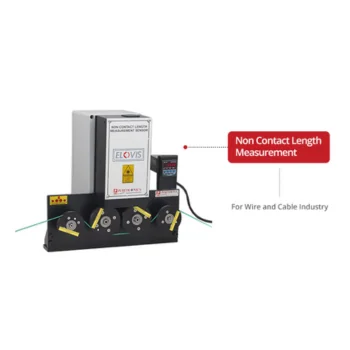
Ask any production manager who relies on a measuring wheel encoder how much they trust its readings, and you'll often get a hesitant answer. Contact-based measurement has been an industry default for decades across many types of manufacturing, but it comes with a quiet, persistent problem: slippage and mechanical wear and tear. Even a small amount of slip between a measuring wheel and a moving material throws off length readings, and that error compounds over long production runs. At Puretronics, we built our Speed Measurement System specifically to eliminate this problem, not by improving the wheel, but by removing contact altogether.
The Problem With Touching What You're Measuring
Every contact-based measurement device shares the same fundamental weakness: physical wear. Measuring wheels wear down over time, their surfaces get contaminated with dust or residue, and once that happens, accuracy drifts without anyone noticing until a discrepancy is flagged downstream. This isn't a problem unique to one type of manufacturing, it shows up wherever continuous material moves fast, gets hot, or has a surface that can't tolerate pressure. A Non-Contact Length measurement approach avoids this entirely, with no wheel to wear down, no surface to slip against, and no mechanical component degrading with every metre that passes through.
Industries That Rely on This Technology
Non-contact measurement solves the same core problem across a surprisingly wide range of industries:
- Wire, Cable, and Extrusion Lines: where length accuracy affects boiling, spooling, and compliance
- Rubber, Hose, and Tube Manufacturing: where soft or heat-sensitive surfaces can't tolerate contact pressure
- Optical Fibre Production: where even light contact risks affecting coating quality
- Textile, Film, and Non-woven Material Production: where thin, fast-moving materials are especially prone to slippage errors
- Paper and Packaging: where continuous rolls need consistent length tracking without surface damage
- Metal Strip and Sheet Processing: where fast-moving or hot surfaces make contact-based sensing risky
- Plastic and Polymer Processing: where freshly formed material is often too soft or hot for a wheel to touch
- Wood and Timber Processing: where uneven, rough or finished surfaces cause wheel slip, and measurement errors lead to wasted cuts
- Speciality and High-Value Materials: where the cost of production or value of the product is high, so every metre lost to measurement error or surface marking is expensive
Across every one of these industries, a length and Speed Measurement System built on non-contact technology solves the same underlying challenge: keeping measurement accurate regardless of surface condition, material type, temperature, or line speed.
Where This Becomes a Real Advantage
Certain production conditions expose the weaknesses of contact-based measurement especially clearly, no matter the industry. High-speed lines make a physical wheel prone to bounce and slip. Delicate, coated, or freshly formed surfaces risk being marked or damaged by wheel pressure. Long, continuous runs allow small errors to accumulate into noticeable discrepancies by the end of production. And hot or heat-sensitive materials often can't safely be measured with a device that needs to touch it at all. A Non-Contact Length system handles all of these conditions without compromising accuracy, regardless of what material is moving through it.
How It Cuts Down Workload Across Industries
Beyond accuracy, one of the most underrated benefits of a non-contact length and Speed Measurement System is how much manual effort it removes from daily operations, whatever the production line looks like:
- Fewer manual re-checks: accurate readings mean operators don't need to periodically verify length using tape measures or manual counters
- Less maintenance labour: no wheel to inspect, clean, or replace, freeing up maintenance staff for higher-priority work
- Reduced calibration cycles: non-contact systems hold their accuracy far longer than wheel-based ones, cutting down recurring calibration work
- Fewer billing disputes to investigate: accurate Non-Contact Length data means fewer hours spent resolving disputes over under- or over-delivered material
- Less scrap investigation time: quality teams spend less time tracing defects back to measurement drift, since the root cause is eliminated
- Faster changeovers: no need to reset or recalibrate a mechanical wheel when switching between material types
- Reduced unplanned downtime: with no wearing part in contact with the material, there are fewer stoppages caused by worn or damaged encoder wheels
In practical terms, this means fewer people spending time on rechecking, recalibrating, and troubleshooting, and more time available for actual production, regardless of the industry it's applied in.
The Maintenance Conversation Nobody Talks About Enough
Ongoing maintenance is often overlooked during purchasing decisions, whatever the application. A wheel-based encoder needs regular inspection, cleaning, and eventual replacement as it wears, and every one of those events is a moment where accuracy can silently degrade before anyone catches it. A Non-Contact Length and speed solution removes much of this burden, keeping accuracy consistent for far longer without manual intervention, across any material or production environment.
What This Means for Your Bottom Line
Length accuracy isn't just a technical detail, it directly affects billing, materials allocation, and how confidently a quality team can sign off on output, no matter the industry. Small, repeated measurement errors from a worn or slipping wheel can quietly cost manufacturers far more in wasted material and corrections than most realize. Switching to a Speed Measurement System built around non-contact technology closes that gap, giving manufacturers measurement data, and freed-up manpower, they can rely on, run after run.
A Smarter Way to Measure, Built for Real Production Conditions
At Puretronics, we designed our system with the understanding that measurement accuracy and the workload behind it, shouldn't get harder the moment a line runs at full speed or a material can't tolerate contact. If inconsistent length reading or frequent encoder maintenance have quietly cost your production time and manpower, it may be time to rethink how you measure.
Frequently Asked Questions
A measuring wheel wears down and can slip against the material, so its readings drift over time. Our non-contact system, developed in collaboration with Elovis Germany, has no part touching the material, so there is nothing to wear or slip.
It's widely used across rubber and hose manufacturing, optical fibre production, textile and film production, paper and packaging, metal strip processing, and plastic and polymer processing.
Yes, since there's no physical contact involved, it can safely measure hot or heat-sensitive surfaces that a contact-based wheel wouldn't be able to touch.
With no wheel in contact with the material, there's nothing to inspect, clean, or replace regularly, which reduces both maintenance labour and calibration frequency.
Inaccurate length readings can lead to billing disputes, wasted material, and rejected batches, so consistent accuracy directly reduces these hidden costs over time.